System Definition

Axenta is an infrastructure for structured thought. We separate evidence from narrative. No metrics, no algorithms, just structure.

Ex Inceptis, Axiomata;
Per Formam, Cognitio.

A calm space for rigorous thinking: hypotheses, formal sketches, notes, and references.
Minimal design. Maximal clarity.

Axenta is a working archive for disciplined thought. It preserves assumptions before they are justified, structures before they are published, and revisions after certainty fails.

This is not a platform for conclusions. It is a system for keeping thought legible while it is still in motion.

System Architecture & Characteristics:

  • A public infrastructure based on the 4-Layer Protocol
  • Epistemic Cartography: Visualization of dependencies between active nodes
  • The Epistemic Nexus: An immutable archive & thinking workspace for research
  • A documentation layer positioned between raw research and public discourse

Structure First

Knowledge is not a stream. It is a structure. Axenta forces every thought into a verifiable architecture.

Archival Thinking

Designed to last. We build for the archive, not the feed. Slow down. Verify. Document.

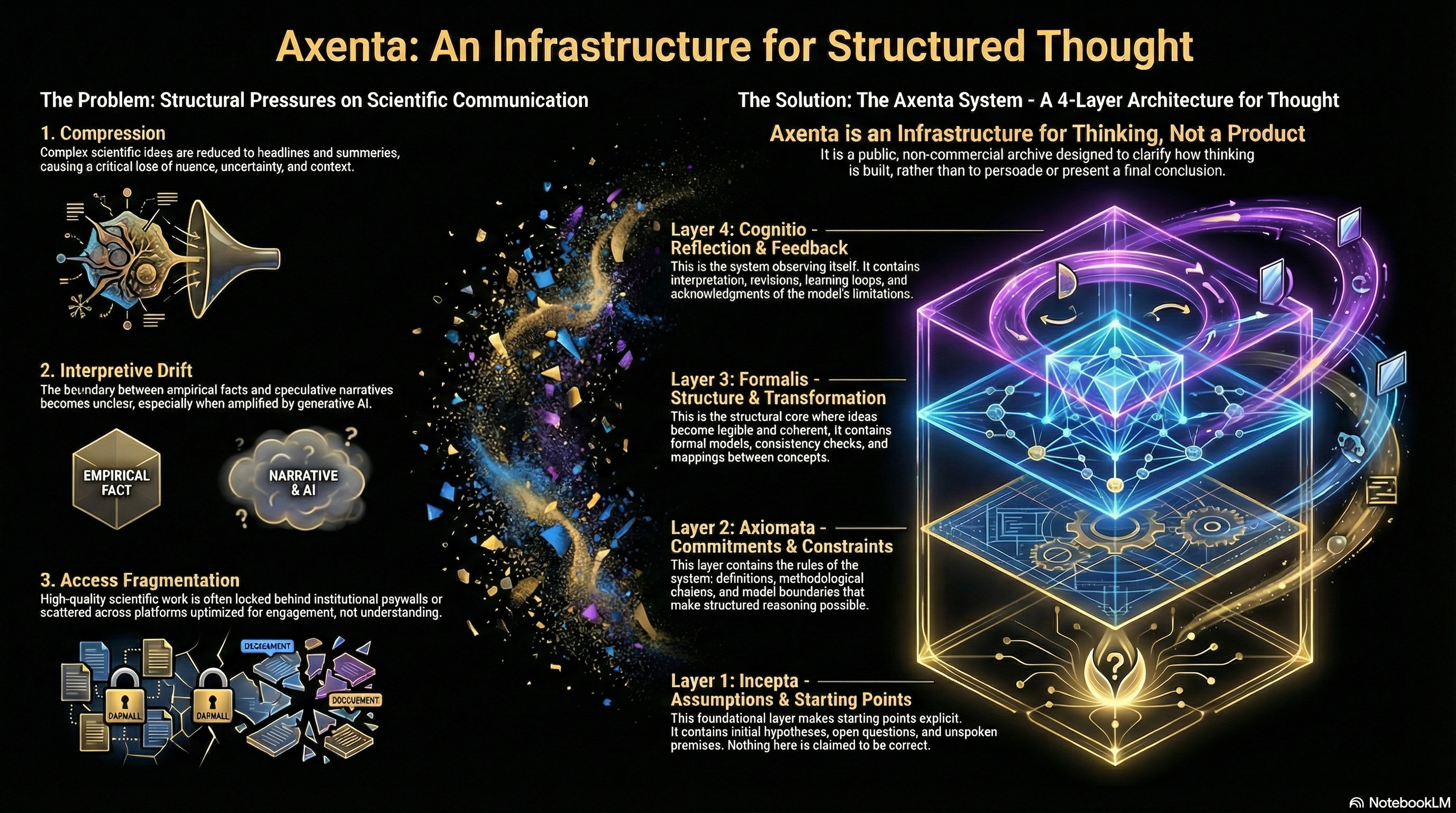
Axenta System Architecture

Figure 1.1: The 4-Layer Architecture for Thought [Click to Expand]

Epistemic Cartography (beta)


Visualization of dependencies and connections between the nodes according to the 4-layer protocol. The cartography is dynamic and updates in real time as soon as new nodes are added. This also updates all dependency and connection paths.

001
002
003
004
005
006
007
008
LATEST

I. Incepta

The Origin. Paradoxes and starting points.

II. Axiomata

Fixed Points. Constants, laws and working constraints.

III. Formalis

The Structure. Mathematical models, proofs and logic.

IV. Cognitio

The Reflection. Philosophically and Reality implications and loops.

SYSTEM INTEGRITY
98.4%

Axenta Core: Real-Time Analysis & System Integrity

The architecture of Axenta_Core* is based on the continuous verification of logical coherence. Two factors play a central role:

Real-Time Analysis: All incoming content is processed immediately upon ingestion and integrated into the existing context. System Integrity (SI): This metric measures the scientific connectivity between individual nodes. A high value confirms logical consistency, while a low value indicates fragmented data or "loose ends."

Epistemic Nexus (beta)

Active Research Nodes

🔍
NODE 009 (LATEST)

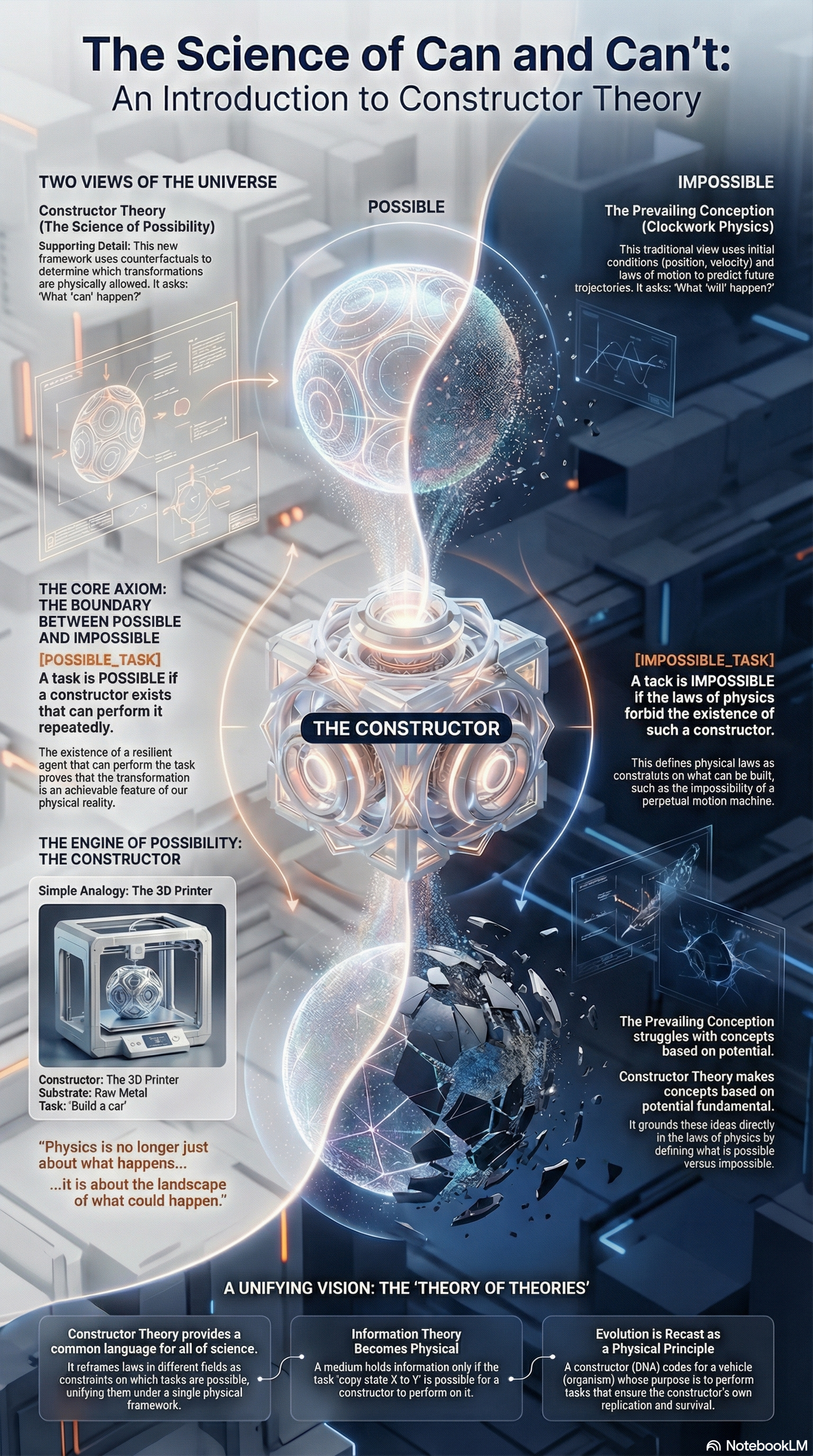
Constructor Theory: The Science of Can and Can't

Author: David Deutsch, Chiara Marletto Ref: constructor_theory_axenta_analysis.pdf

A new fundamental framework that rewrites the laws of physics not as predictions of what will happen, but as statements about what transformations are possible and which are impossible.
I. Incepta (The Limits of Trajectories)

The Prevailing Conception: Since Newton, physics has focused on initial conditions and laws of motion to predict trajectories. This works for planets, but fails for concepts defined by potentiality (Counterfactuals) like Information or Life.

II. Axiomata (Laws of Possibility)

The Task: The fundamental primitive is the "Task" (a transformation).
Core Axiom: A task is possible if a Constructor exists that can perform it and retain the ability to do so again. A task is impossible if physics forbids such a constructor.

III. Formalis (The Constructor)

Definition: An entity that causes change without changing itself.
Analogy (Catalyst): A chemical catalyst enables a reaction but isn't consumed.
Simple (3D Printer): A machine that builds a car from metal. The metal changes; the machine stays a machine. If the machine survives, the task is possible.

IV. Cognitio (Theory of Theories)

Unification: This framework unifies distinct fields. Information exists if the task "copy X to Y" is possible. Evolution is a constructor (DNA) coding for a vehicle to sustain itself. Physics becomes the map of the possible.
NODE 008

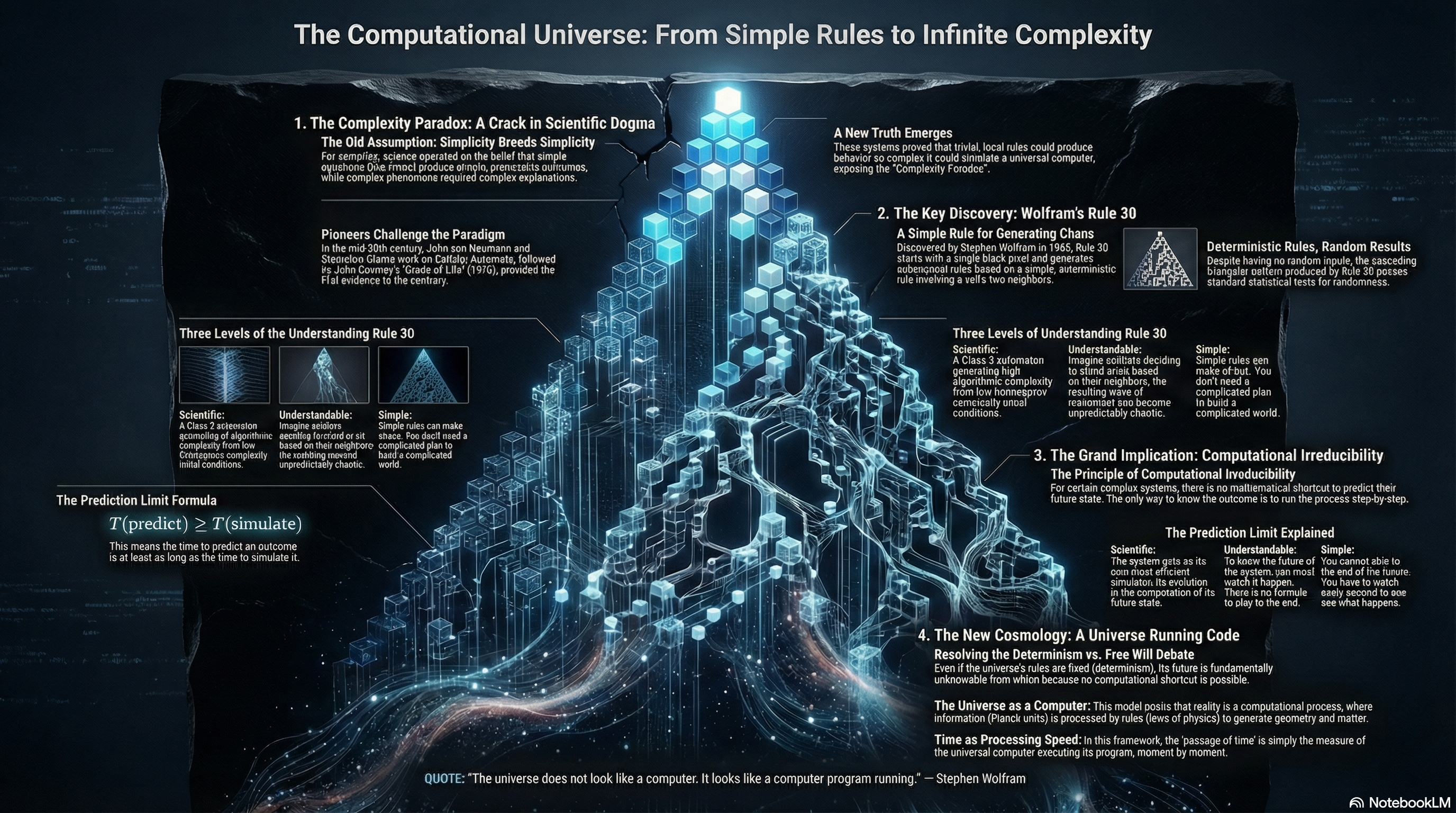
The Computational Universe: Rule 30 & Irreducibility

Author: Stephen Wolfram / Axenta Analysis Ref: computational_universe_axenta_analysis.pdf

Simple, deterministic rules can generate infinite complexity. The universe is not a machine defined by formulas, but a discrete computational process.

I. Incepta (The Complexity Paradox)

The Assumption: For centuries, science assumed that simple formulas produce simple outcomes (like F=ma). Complex phenomena (biology) were thought to require complex equations.
The Shift: Cellular Automata (Conway's Game of Life) revealed that extreme complexity can emerge from trivial starting conditions.

II. Axiomata (Rule 30)

The Discovery: Stephen Wolfram analyzed 256 elementary rules. "Rule 30" starts with one black pixel and follows a simple deterministic rule, yet produces a mathematically random pattern.
Scientific: Class 3 automata generate intrinsic randomness from low Kolmogorov complexity.
Analogy: A row of soldiers following a simple instruction ("If left neighbor stands, I sit") creates a chaotic, unpredictable wave.
Simple: Simple rules can make chaos.

III. Formalis (Computational Irreducibility)

The Prediction Limit: For such systems, there is no mathematical shortcut to the future. To predict the state at step N, you must simulate N steps.

TpredictTsimulate

Analogy: You cannot skip to the end of the movie. You have to watch every second to see what happens. The universe is computing its future right now.

IV. Cognitio (Time as Computation)

The Nature of Reality: The universe is not merely described by math; it is a running program. Time is the processing speed of the cosmic computer.
Free Will: Even in a deterministic universe, the future is fundamentally unknowable until it happens. We are the result of the computation.

NODE 007

Dissipative Adaptation: The Physics of Life

Author: Jeremy England / Axenta Analysis Ref: dissipatice_adaption_axenta_analysis.pdf

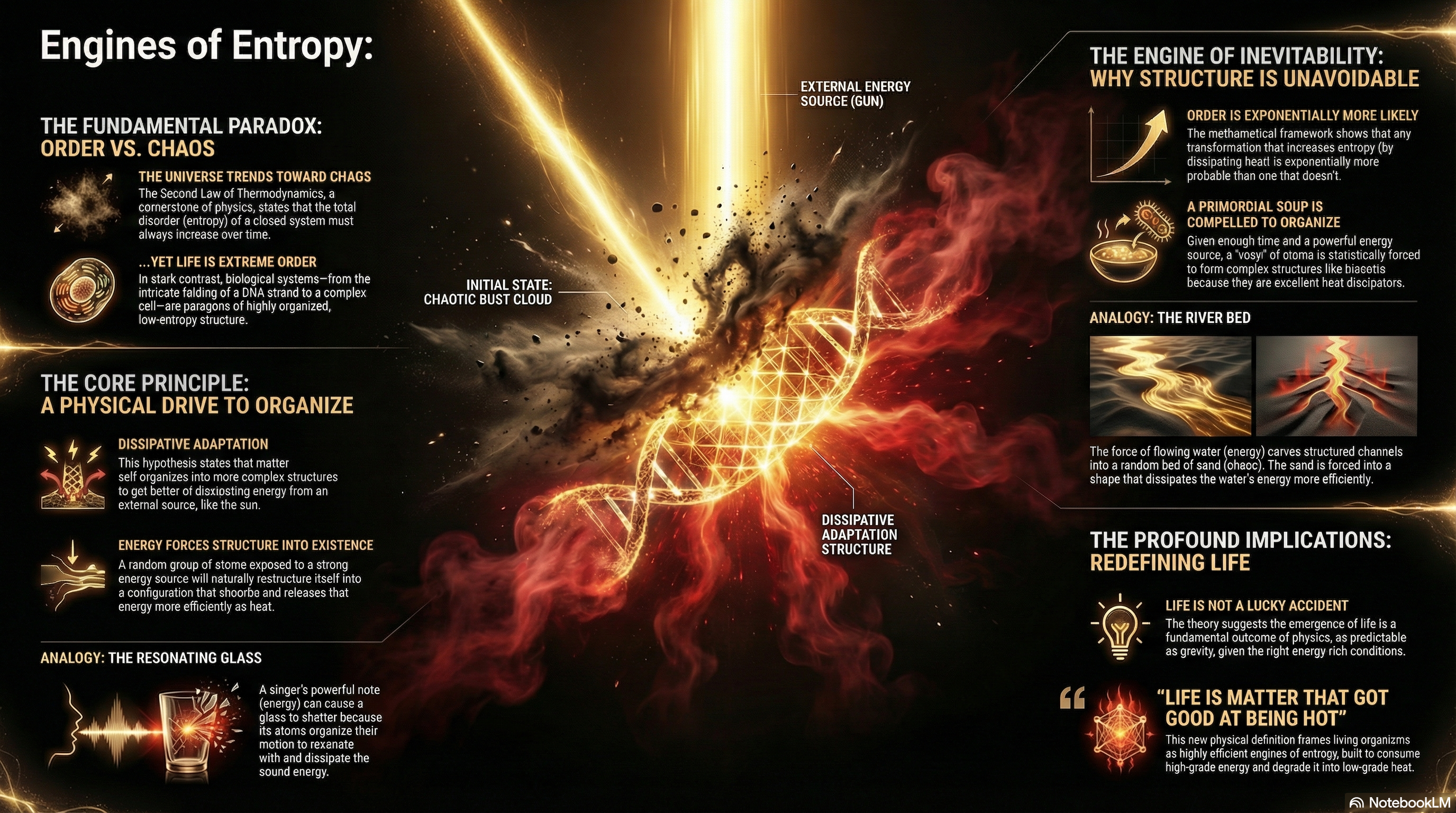
Life is not a random accident. It is a thermodynamic necessity. Matter self-organizes into complex structures to dissipate energy more efficiently.

I. Incepta (The Entropy Paradox)

The Contradiction: The Second Law of Thermodynamics dictates that the universe tends toward chaos (increasing entropy). Yet, biological life is highly ordered.
Resolution: Erwin Schrödinger proposed that life maintains its internal order by actively exporting disorder (heat) to the environment. Life accelerates entropy production.

II. Axiomata (The Physical Drive)

Adaptation Principle: Jeremy England posits that matter, when driven by an external energy source, will naturally restructure itself to dissipate that energy better.
Analogy: Like a river carving channels in sand to flow more efficiently, energy flows carve "structure" into matter. The sand doesn't choose to organize; the physics of the flow compels it.

III. Formalis (The Inevitability)

Statistical Probability: The generalized fluctuation theorem demonstrates that outcomes producing more entropy are exponentially more likely:

P(A → B) P(B → A) ≈ eΔS

Analogy (Resonance): If an opera singer hits a specific note, a glass shatters. The glass's structure adapts (resonates) to absorb the energy. Life is matter resonating with the sun.

IV. Cognitio (Entropy Engines)

Redefining Life: Life is not a biological lucky break, but a physical inevitability. We are "entropy engines"—matter that got good at being hot. Evolution is just a mechanism for finding better ways to degrade energy.

NODE 006

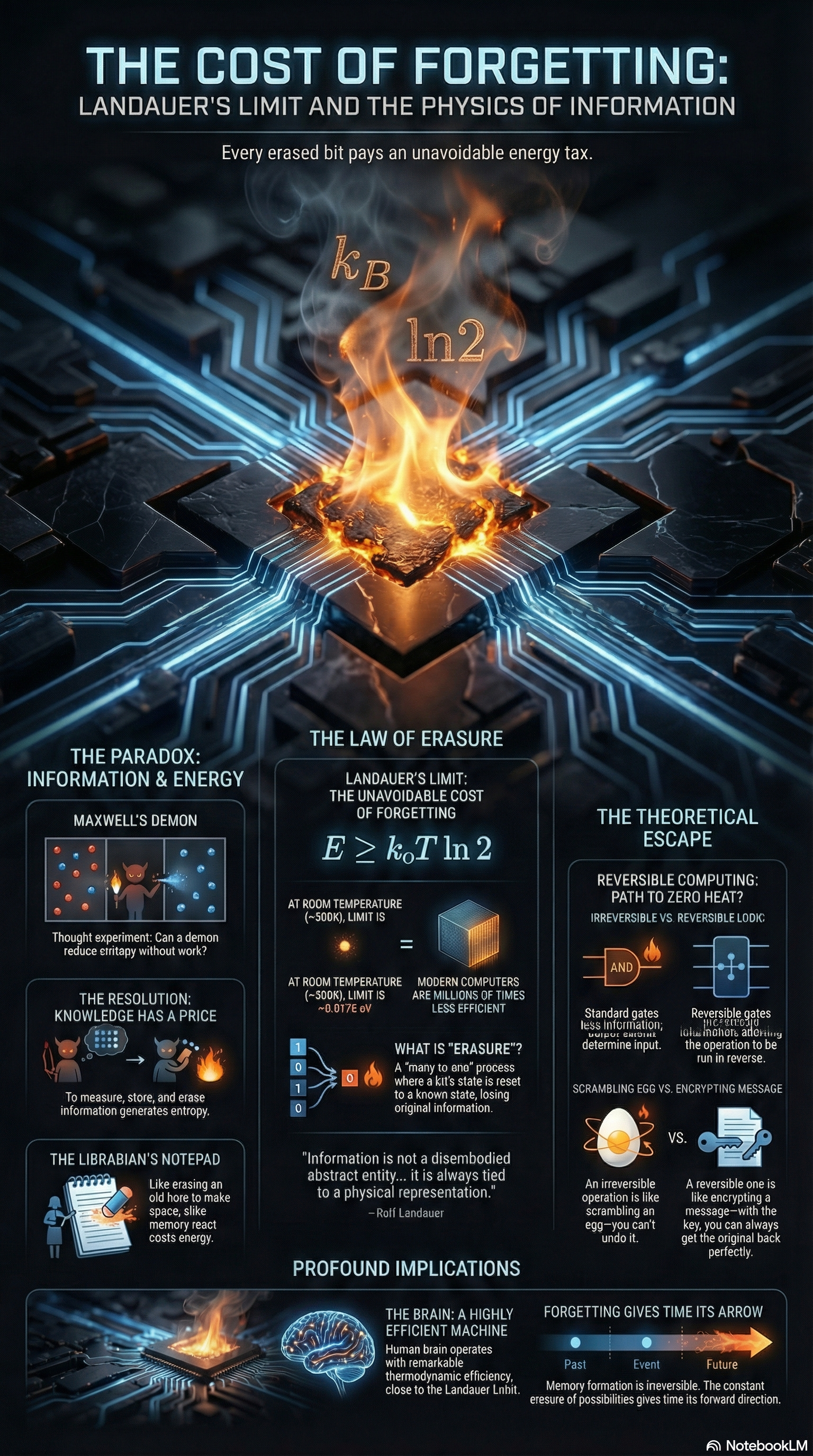
The Landauer Limit: The Physics of Forgetting

Author: Rolf Landauer / Axenta Analysis Ref: landauer_limit_axenta_analysis.pdf

Information is physical. The erasure of data is a thermodynamically irreversible process that carries an unavoidable energy cost. To forget is to burn energy.

I. Incepta (Maxwell's Demon)

The Paradox: In 1867, Maxwell imagined a demon that could sort molecules to decrease entropy without work.
The Resolution: The demon must measure and remember particle speeds. Erasing its memory to make room for new data generates the missing entropy.
Analogy: A librarian sorting books (demon) must erase their notes to start a new batch. The physical act of erasing the notepad costs energy.

II. Axiomata (The Physical Cost)

The Limit: Rolf Landauer proved that any logically irreversible operation (erasure) must dissipate heat. The minimum energy (E) to erase one bit is:

EkB T · ln 2

Analogy: "Forgetting" is like resetting a switch. If it's already off, it costs nothing. If it's on, you must physically push it down, releasing heat.

III. Formalis (Reversible Computing)

Bypassing the Limit: Standard logic gates (AND/OR) are irreversible; inputs are lost. Reversible gates (Toffoli/Fredkin) preserve all inputs, theoretically dissipating zero heat.
Analogy: Irreversible is like making orange juice (you can't unsqueeze it). Reversible is like building with LEGOs (you can always disassemble perfectly).

IV. Cognitio (The Arrow of Time)

Biological Implications: The human brain is remarkably efficient, operating close to the Landauer Limit.
Time: We remember the past but not the future because memory formation is an entropy-increasing process. The "arrow of time" is driven by the thermodynamic cost of forgetting.

NODE 005

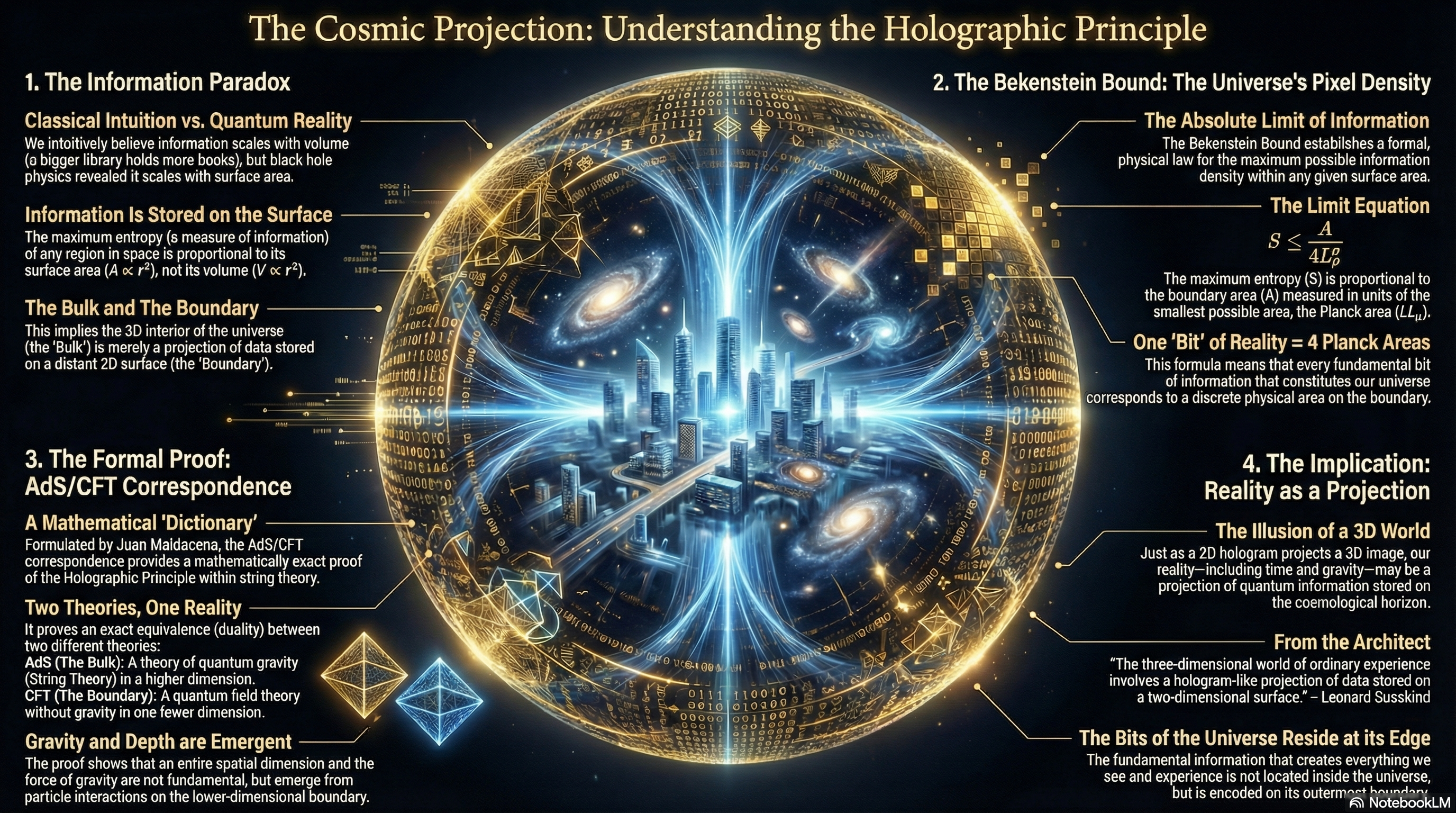
The Holographic Principle: Reality as Projection

Author: Maldacena, 't Hooft, Susskind Ref: holographic_principel_Axenta_Analysis.pdf

The maximum entropy of any given region of space does not scale with its volume, but strictly with its surface area.

I. Incepta (The Volume Anomaly)

The Paradox: In classical physics (like a library), information scales with volume (V ∝ r3). However, black hole thermodynamics revealed a startling anomaly: Entropy scales strictly with the surface area (A ∝ r2). The "inside" is defined by the "outside".

II. Axiomata (The Bekenstein Bound)

Information Limit: The absolute limit of information density (S) is defined by the Planck area (LP2).

S Area 4 LP2

For every bit of information, there corresponds a discrete physical area of four squared Planck units on the boundary.

III. Formalis (The Proof)

AdS/CFT Correspondence: Juan Maldacena formulated the exact proof in String Theory. It establishes a duality between Gravity in the Bulk and Quantum Field Theory on the Boundary.

ZGrav(Bulk) = ZCFT(Boundary)

The universe is mathematically isomorphic to a hologram. Gravity and the third dimension are emergent properties.

IV. Cognitio (The Projection)

Nature of Reality: The three-dimensional world of ordinary experience is a projection of data stored on a 2D surface. The "bits" of reality are not located inside the universe, but on its edge.

NODE 004

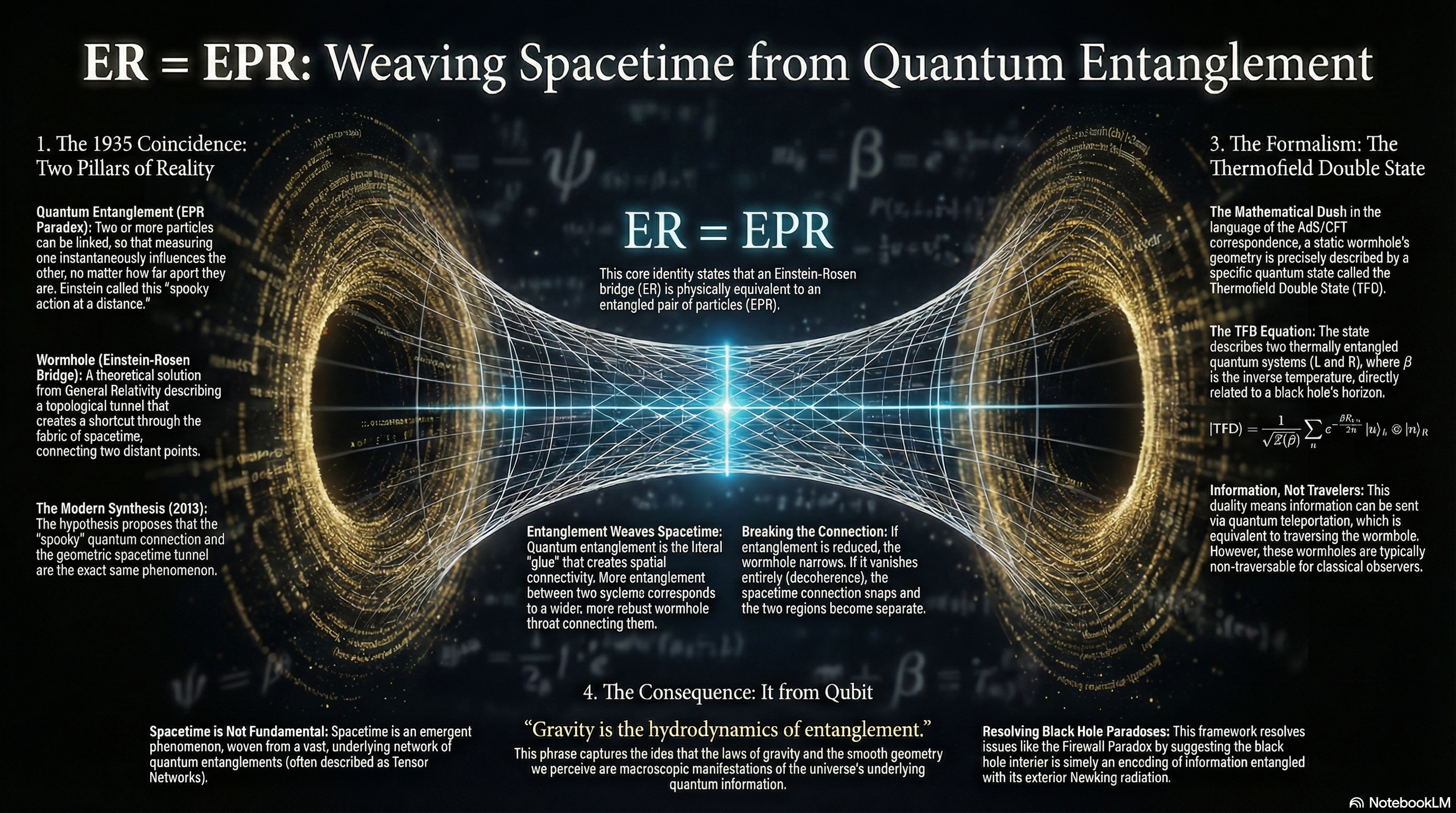
ER = EPR: The Geometrization of Entanglement

Author: Maldacena, Susskind / Axenta Analysis Ref: ER_EPR_Axenta_Analysis.pdf

A structural analysis of the hypothesis that quantum entanglement (EPR) and Einstein-Rosen bridges (ER) are physically equivalent realities.

I. Incepta (The Origin)

The 1935 Coincidence: Einstein published two contradictory papers in the same year: one on "spooky action" (EPR) and one on wormholes (ER). For decades, General Relativity and Quantum Mechanics were seen as incompatible.

II. Axiomata (The Fixed Points)

Geometry equals Information: The central axiom states that spatial connectivity is generated by entanglement. The formula is literal:

ER  =  EPR

Entanglement is the "glue" that binds spacetime. Without it, space creates disjoint islands.

III. Formalis (The Structure)

The Thermofield Double: In the AdS/CFT correspondence, a wormhole is described by the Thermofield Double State (|TFD⟩). The geometry is defined by thermal entanglement:

|TFD⟩ = 1 √Z(β) ∑ e-βEn/2 |n⟩L|n⟩R

Traversing the wormhole corresponds to quantum teleportation of information between the entangled boundaries.

IV. Cognitio (The Reflection)

It from Qubit: Spacetime is not a fundamental container but an emergent phenomenon woven from tensor networks. "Gravity is the hydrodynamics of entanglement".

NODE 003

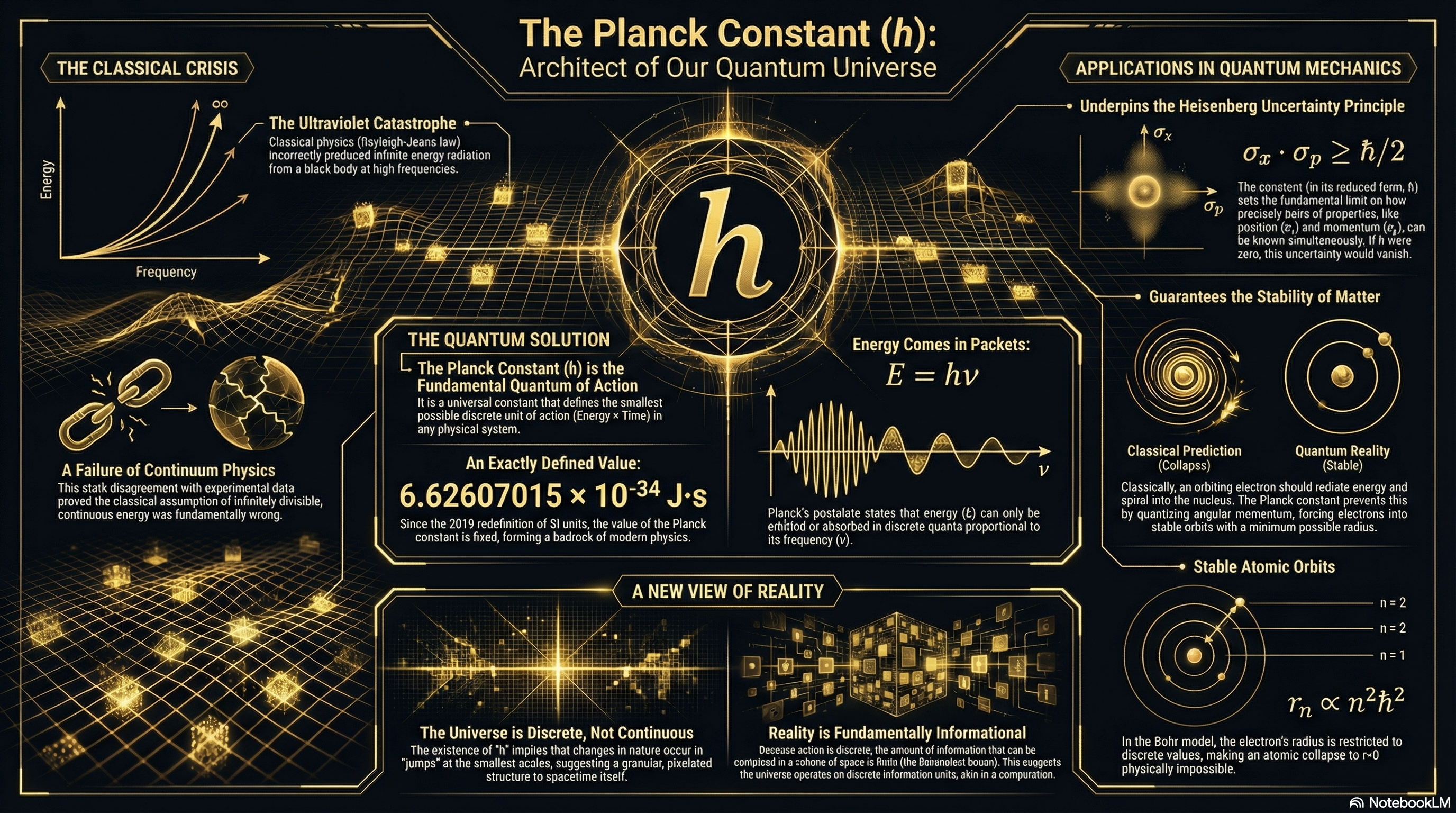
The Planck Constant (h): The Source Code of Reality

Author: Max Planck / Axenta Analysis Ref: planck_constant.pdf

An analysis of the absolute lower limit of action (h). This node documents the transition from a continuous (analog) to a discrete (digital) understanding of the universe.

I. Incepta (The Origin)

The Ultraviolet Catastrophe: Classical physics predicted that a black body would radiate infinite energy at high frequencies. This logical failure proved that the "continuum" model of nature was flawed.

II. Axiomata (The Fixed Points)

Quantization of Action: Energy is not continuous but packetized. The size of these packets is defined by E = h · f.
h ≈ 6.626 × 10⁻³⁴ J·s. This is the fundamental pixel size of the universe.

III. Formalis (The Structure)

Atomic Stability: The existence of h prevents electrons from collapsing into the nucleus. The discrete orbits (n = 1, 2...) create the stability of matter:

rn = 4πε02 mee2 · n2

Without h, no atom would be stable for more than a fraction of a second.

IV. Cognitio (The Reflection)

Ontological Shift: "Natura non facit saltus" (Nature makes no jumps) is false. The universe is granular. Information is finite. This suggests reality has a resolution limit.

NODE 001

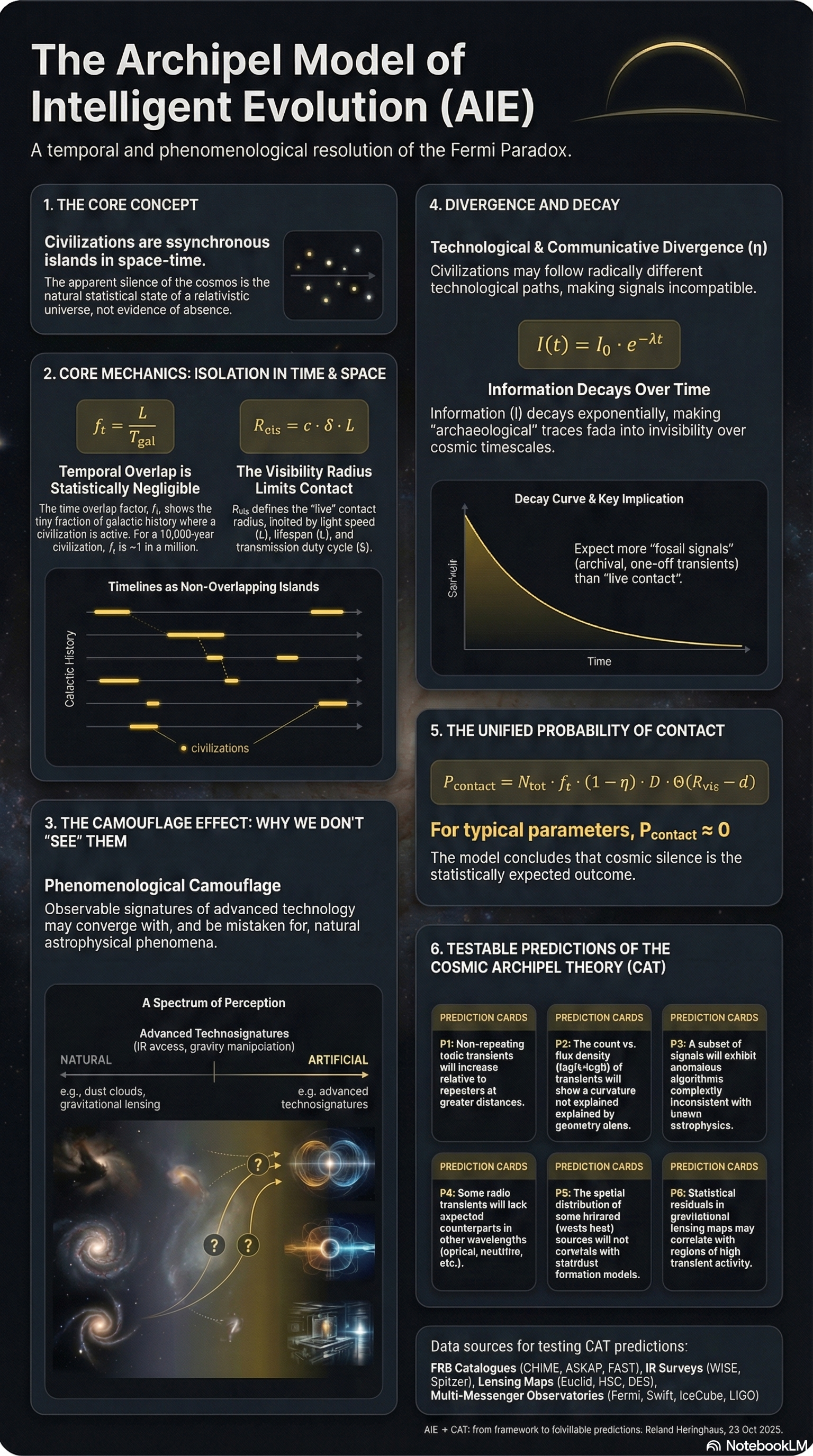
The Archipel Model of Intelligent Evolution (AIE)

Author: R. Heringhaus Ref: CAT_Theory.pdf

A temporal and phenomenological resolution to the Fermi Paradox.

I. Incepta

Contradiction: High probability of life vs. zero contact. "Absence of evidence" is not evidence of absence.

II. Axiomata

Asynchronicity: Civilizations are islands in time. The variable ft (Time Overlap) determines contact probability.

III. Formalis

The Model: We calculate the Time Overlap Factor:

ft = L Tgal

We search for archival signals (artifacts), not live calls.

IV. Cognitio

Conclusion: We are isolated in time. The silence is a statistical necessity.

NODE 002

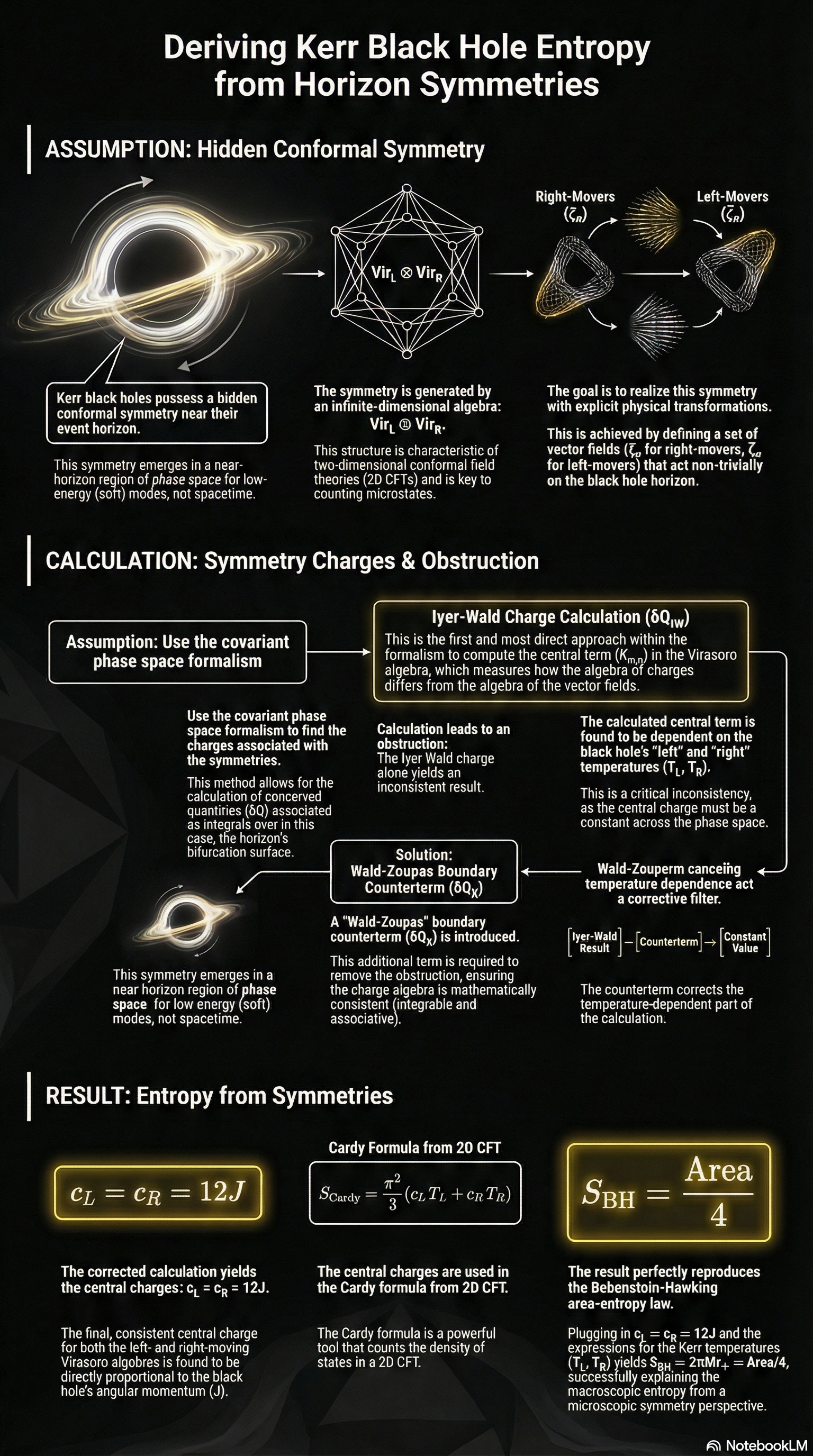
Black Hole Entropy and Soft Hair

Author: Hawking, Perry, Strominger Ref: Black_Hole_Entropy_Soft_Hair.pdf

Soft Hair describes zero-energy quantum excitations at the event horizon that can store information.

I. Incepta

The Paradox: Information loss in black holes violates Quantum Mechanics (Unitarity).

II. Axiomata

Soft Gravitons: Zero-energy particles generate symmetries (Supertranslations) at the horizon.

III. Formalis

The Mechanism: Central charges c = 12J in the Cardy Formula reproduce the Entropy:

S = Area 4
IV. Cognitio

Conclusion: Black holes record their history on their "skin" (horizon). Information is preserved.

The Protocol

Standardized Cognitive Architecture
I

Incepta

The Origin. Questions, observations, and anomalies.

II

Axiomata

The Fixed Points. Definitions, constants, and accepted truths.

III

Formalis

The Structure. Logic, mathematics, and connections.

IV

Cognitio

The Reflection. Meta-analysis, limitations, and recursion.

The Rationale: Why we structure thought.

// 01 COUNTERACTING FRAGMENTATION

We live in an era of headlines without context and social media science without sources. The Protocol acts as a filter against this entropy. By forcing every topic—whether a physics paper or a philosophical concept—into this 4-layer architecture, we ensure that no claim stands without its origin (Incepta) and no theory exists without its constraints (Axiomata).

// 02 UNIVERSAL ACCESSIBILITY

Axenta is designed to be a bridge. It serves as a trusted library for teachers, academics, and researchers, while simultaneously offering a structured entry point for the curious non-expert. It removes the barrier of academic jargon without sacrificing the depth of the content, creating a verified source of truth.

// 03 THE DEEP DIVE MECHANISM

Scenario: You encounter a viral science post lacking context. Instead of skimming, you turn to Axenta.
Search → Verify → Map.
You find the Node in the Nexus, read the structured analysis free from noise, and then use the Epistemic Cartography to explore how this topic connects to the broader scientific landscape.

// 04 ARCHIVAL TRUST

In a digital world optimized for engagement and speed, Axenta optimizes for permanence and clarity. The Protocol ensures recognition and trust. If it is on Axenta, it has been stripped of narrative and reduced to its structural core. This is an archive for the long term, not a feed for the moment.

System Meta Data & Uplink

Legal Disclosure & Communication Channels

Active Signal Channels

Legal Parameters (Impressum)

Operator / Name Roland Heringhaus
Coordinates Ringmauerweg 3
69250 Schönau
Germany
Content Responsibility Verantwortlich nach § 18 Abs. 2 MStV:
Roland Heringhaus (Address above)
Social Scope This legal disclosure also applies to the social media profiles linked above (YouTube: @Axentanet, Instagram: @ronnvandee).
Dispute Resolution EU Commission platform for online dispute resolution: https://ec.europa.eu/consumers/odr